
Blogs
Insights & Strategies for Your Financial Journey
Stay informed with expert articles, tips, and updates on retirement planning, wealth protection, business strategies, and family financial planning—designed to help you make confident financial decisions.
Roth Vs. Traditional: Which Is Better For Your 2026 Retirement Strategy?
Roth Vs. Traditional: Which Is Better For Your 2026 Retirement Strategy?
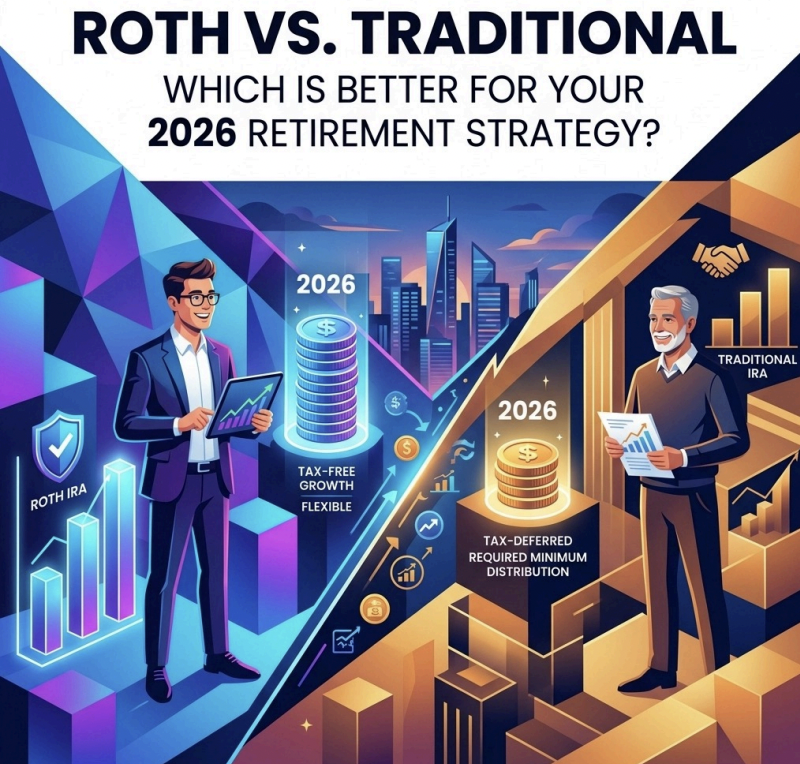
Choosing the right retirement account often feels like picking a lane on a busy highway. In 2026, the financial landscape has shifted slightly, making the choice between a Roth and a Traditional retirement account more relevant than ever. For families trying to secure their children’s future or business owners looking to optimize their tax strategy, understanding these differences is a foundational step in wealth management.
The decision is not just about where the money goes today. It is about where the money stays tomorrow. Both accounts offer tax advantages, but they apply those advantages at different stages of the journey. Whether an individual prefers a tax break right now or tax-free income in the future depends on a few specific factors including income, age, and long-term goals.
The Basics of Traditional Retirement Accounts
A Traditional IRA or 401(k) is built on the principle of "pay later." When money is contributed to a Traditional IRA, it is often tax-deductible. This reduces the contributor’s taxable income for the current year, which can be a significant benefit for families in a high tax bracket today.
The trade-off happens during retirement. When the money is withdrawn, it is taxed as regular income. For many, the logic is that they will be in a lower tax bracket during retirement than they are during their peak earning years. If that holds true, the Traditional approach saves money over the long term.
However, Traditional IRAs come with strings attached. Once an individual reaches age 73, the government requires them to start taking money out, whether they need it or not. These are called Required Minimum Distributions (RMDs). This lack of flexibility can sometimes push retirees into higher tax brackets than they anticipated.

The Roth Strategy: Tax-Free Growth
A Roth account flips the script. There is no tax deduction for contributions made today. The money goes in after taxes have already been paid. The benefit is found at the finish line: all qualified withdrawals in retirement are completely tax-free.
For families in 2026, the Roth IRA is often viewed as a "tax hedge." If tax rates rise in the future, those with Roth accounts are protected because they have already settled their bill with the IRS. Additionally, Roth IRAs do not have RMDs during the owner’s lifetime. The money can stay in the account and continue to grow tax-free for as long as the owner lives, making it a powerful tool for those who want to leave a legacy for their heirs.
One of the most casual and helpful features of the Roth IRA is its flexibility. Contributions (the actual money put in, not the earnings) can be withdrawn at any time without taxes or penalties. While it is usually best to leave retirement money alone, having that "emergency valve" provides peace of mind for many households.
2026 Income Limits and Contributions
The IRS updates the rules for these accounts periodically. In 2026, the contribution limits for both account types have stabilized, allowing individuals to save a significant amount.
For 2026, the annual contribution limit for both Roth and Traditional IRAs is $7,500. For those age 50 and older, a "catch-up" contribution of $1,100 is allowed, bringing the total to $8,600. These contributions must be made by the tax filing deadline, which for the 2026 tax year is April 15, 2027.
However, Roth IRAs have income phase-out thresholds. In 2026, single filers can only contribute the full amount if their modified adjusted gross income (MAGI) is below $153,000. Partial contributions are allowed up to $168,000. For married couples filing jointly, the full contribution threshold is below $242,000, with partial contributions allowed up to $252,000.
Traditional IRAs do not have income limits for making contributions, but they do have limits on whether those contributions are tax-deductible if the individual or their spouse has access to a retirement plan at work.

The New Rule for High Earners (Age 50+)
A major change hitting the scene in 2026 involves high earners who are 50 or older. Under new regulations, if an employee earns $150,000 or more in FICA income, any catch-up contributions made to their workplace 401(k) must be directed to a Roth account.
This is a significant shift. Previously, these high earners could choose to put that extra money into a Traditional, tax-deferred account. Now, the government is essentially mandating a "pay-now" tax structure for these specific contributions. While it removes the immediate tax deduction, it sets these individuals up for more tax-free wealth in their later years. This makes it even more important for business owners and executives to review their investment management strategies.
Comparing the Long-Term Impact
When deciding between the two, it helps to look at the math. The impact of taxes over thirty years can be just as significant as the impact of fees. Strategic planning involves looking at the "net" amount that actually ends up in the bank account after the IRS takes its share.

The graphic above illustrates how even small percentages: like a 1% fee: can drain hundreds of thousands of dollars over a career. Taxes function in a similar way. If an individual chooses a Traditional account but tax rates double by the time they retire, they may find that a large portion of their "savings" actually belongs to the government. This is why a balanced approach, sometimes using both types of accounts, is often the most resilient strategy.
Which One Is Right for a 2026 Strategy?
There is no single "better" option. The choice depends on a few simple questions:
1. What is the current tax bracket? If an individual is currently in the highest tax bracket they expect to ever be in, the immediate deduction of a Traditional IRA is hard to pass up.
2. What is the age of the contributor? Younger investors have more time for their money to grow. Since that growth is tax-free in a Roth, the younger an individual is, the more they usually benefit from the Roth option.
3. Is flexibility a priority? For those who want to avoid RMDs and keep their money growing indefinitely, the Roth is the clear winner.
4. Is there a need for a tax break today? For a growing family or a new business owner, every dollar counts. A Traditional IRA provides that immediate relief on the annual tax bill.

How WealthGuard Solutions Can Help
Navigating the nuances of tax codes and retirement limits can feel overwhelming, especially when the rules change from year to year. At WealthGuard Solutions, the goal is to take the guesswork out of the process.
The team provides personalized guidance tailored to the specific needs of families and business owners. Retirement planning is not a "set it and forget it" task. It requires regular check-ins to ensure that the chosen path still aligns with the current tax laws and personal goals. Whether it is determining if a Roth conversion makes sense or optimizing a 401(k) at work, having a professional perspective ensures no opportunities are missed.
For those interested in diving deeper into these topics, the WealthGuard Solutions blogs offer a variety of resources on wealth preservation and strategic planning.
Taking the Next Step
The best time to decide on a 2026 retirement strategy is now. Waiting until the end of the year often leads to rushed decisions or missed contribution windows.
Individuals can start by reviewing their current income and projected tax bracket. If the path forward is still unclear, reaching out for professional advice can provide the clarity needed to move forward with confidence. You can learn more about the team and their approach by visiting the About Us page or by heading directly to the Contact page to schedule a conversation.
Secure retirement planning is about more than just picking a number. It is about understanding the rules of the game and using them to build a lasting legacy. Whether a Roth or a Traditional account is the right fit, the most important step is simply to start saving.

Wealth Guard Solutions
Strategic financial solutions designed to help families and business owners grow, protect, and transfer wealth with confidence.



Quick links
Copyright 2026. Wealth Guard Solutions. Web Design by Erika Vidal Agency. All rights reserved.