
Blogs
Insights & Strategies for Your Financial Journey
Stay informed with expert articles, tips, and updates on retirement planning, wealth protection, business strategies, and family financial planning—designed to help you make confident financial decisions.
How to Build a ‘Family Bank’ That Funds College and Your Retirement at the Same Time
How to Build a ‘Family Bank’ That Funds College and Your Retirement at the Same Time.

Most people believe they have to choose between two of the biggest financial milestones in life: paying for their children’s college education or saving for their own retirement. It often feels like a zero sum game. If you put money into a 529 plan for a child’s tuition, that is money that isn’t going into your 401(k) or IRA.
This "either/or" mentality creates a lot of stress for families. Parents want to give their children a head start without student loans, but they also do not want to become a financial burden on those same children later in life.
There is a strategy that allows a family to address both needs using the same dollar. This strategy is often called a “Family Bank.” By using modern life insurance solutions like Index Universal Life (IUL) or Whole Life insurance, families can create a private reserve of capital. This reserve can fund college, provide retirement income, and protect the family's wealth across generations.
The Problem with Traditional Savings
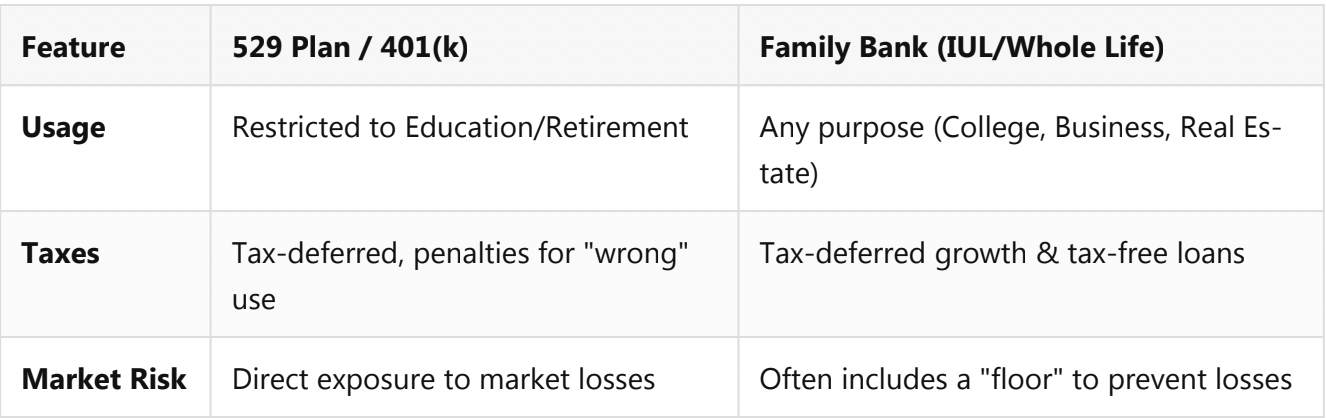
The traditional way to save for college is a 529 plan. These plans are popular because they offer tax free growth and tax-free withdrawals for education. However, they are very restrictive. If a child decides not to go to college, or if they get a full scholarship, getting that money out for other purposes often involves taxes and penalties.
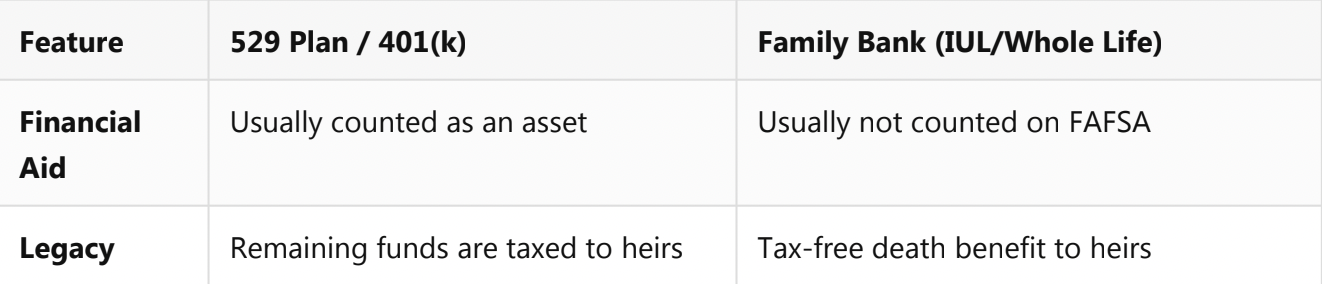
Furthermore, money sitting in a 529 plan is usually counted against the family when applying for financial aid. It is an asset that is "locked in" to one specific purpose.
Retirement accounts like the 401(k) have similar restrictions. If you need to access that money before age 591⁄2 for a child's tuition, you might face a 10% penalty plus income taxes. These "buckets" of money are siloed. They don't talk to each other, and they don't help you with multiple goals at once.
What is a Family Bank?
The concept of a Family Bank is simple: you become your own lender. Instead of keeping your cash in a traditional bank account or a restrictive government plan, you place it inside a permanent life insurance policy.
This isn't the basic "term insurance" that most people are familiar with. This is a policy designed with a "cash value" component. As you pay premiums, a portion of that money builds up inside the policy. This cash value grows over time, often tied to a market index (in the case of an IUL) or through dividends (in a Whole Life policy).
The "Bank" part happens when you need money for a major expense, like college tuition. Instead of withdrawing the money and stopping its growth, you take a loan against the policy.

How the Strategy Works for College
When it is time for a child to head to university, the Family Bank goes to work. Instead of taking out a high-interest federal or private student loan, the parents take a policy loan from the life insurance. Because it is a loan against the cash value, the money inside the policy continues to grow as if you never touched it. This is known as "uninterrupted compound interest."
Here is the process:
1. The family borrows $30,000 for tuition from the policy.
2. The $30,000 stays in the policy, earning interest or index gains.
3. The family pays the tuition.
4. After graduation, the child (or the parents) can pay back the policy loan over time.
This teaches the next generation about the value of interest and repayment, but the "interest" essentially stays within the family’s ecosystem rather than going to a big bank. If the child gets a scholarship, the money is still there for a house down payment or a business startup. There are no "qualified education expense" rules to worry about.
Funding Retirement at the Same Time
The most powerful part of this strategy is what happens after the college years. Because the money inside the policy was never actually withdrawn: it was just used as collateral for loans: it has been compounding for decades.
By the time the parents reach retirement age, the cash value has often grown significantly. At this stage, the policy can transition into a tax-free retirement income stream.
Under current tax laws, policy loans are not considered taxable income. This allows retirees to supplement their Social Security and other retirement accounts with tax-free distributions from their "Family Bank." This can be a huge advantage when trying to stay in a lower tax bracket during retirement.

Asset Protection and Privacy
Another reason high-net-worth families use the Family Bank strategy is for asset protection. In many states, the cash value of a life insurance policy is protected from creditors and lawsuits. If a business owner faces a legal challenge, the money inside their "Bank" is often safe.
Additionally, life insurance cash value is generally not reported on the FAFSA (Free Application for Federal Student Aid). This means that a family could have a significant amount of wealth stored in a Family Bank without it hurting their child's chances for need-based financial aid. This is a major contrast to 529 plans or traditional savings accounts.
Wealth Transfer and the Death Benefit
While the "living benefits" (college and retirement) are the primary focus for many, we cannot forget the "life insurance" part of the policy.
When the parents eventually pass away, the policy pays out a death benefit to the heirs. This benefit is almost always income-tax-free. This provides a final "infusion" of capital into the Family Bank, ensuring that the next generation has even more resources to work with.
It creates a cycle of wealth. The parents use the bank for college and retirement, the death benefit refills the bank, and the children use it for their own retirement and their own children’s college. This is how "generational wealth" is built.
Is This Strategy Right for Everyone?
Building a Family Bank requires a long-term commitment. It is not a "get rich quick" scheme. It requires consistent funding and a clear understanding of how policy loans work.
However, for families who are already saving for the future and want more flexibility than traditional plans offer, it is a proven alternative. It turns a "cost" (college) into an "investment" (the policy) and ensures that your retirement isn't sacrificed for your child’s degree.

Comparing the Options
To help visualize the difference, let’s look at how the Family Bank compares to a standard savings approach:

Taking the Next Step with WealthGuard Solutions
At WealthGuard Solutions, we specialize in helping families design these "private banking" systems. We look at your current cash flow, your goals for your children, and your vision for retirement to see if an IUL or a specialized Whole Life policy fits your needs.
Our goal is to move you away from the "either/or" trap and into a position of "and." You can fund college and you can have a comfortable retirement.
If you are curious about how the numbers would look for your specific family situation, we invite you to explore our services or reach out to us directly through our contact page. You can also learn more about our philosophy on our about page.
Building a Family Bank is about more than just money; it is about creating a financial foundation that gives your family freedom, protection, and a lasting legacy. It is time to stop thinking like a borrower and start thinking like a banker.

Wealth Guard Solutions
Strategic financial solutions designed to help families and business owners grow, protect, and transfer wealth with confidence.




Quick links
Copyright 2026. Wealth Guard Solutions. Web Design by Erika Vidal Agency. All rights reserved.